
What it takes for a newsroom of one to buy its hometown legacy paper, step-by-step
Jun 21, 2026
Years before Amy Bushatz bought her hometown's 80-year-old newspaper, she founded the Mat-Su Sentinel with exactly that purpose in mind. This story shows how a solopreneur pulled off one of the rarest moves in local news.
By Elaine Díaz Rodríguez
Amy Bushatz is going to be late for the city council meeting, which is the kind of meeting where she needs to be there for the beginning. "Please hold," she said, mid-sentence, mid-interview, mid-drive. "I am driving by the Frontiersman building right now, and there is an update in front of this building. I have to show you this."
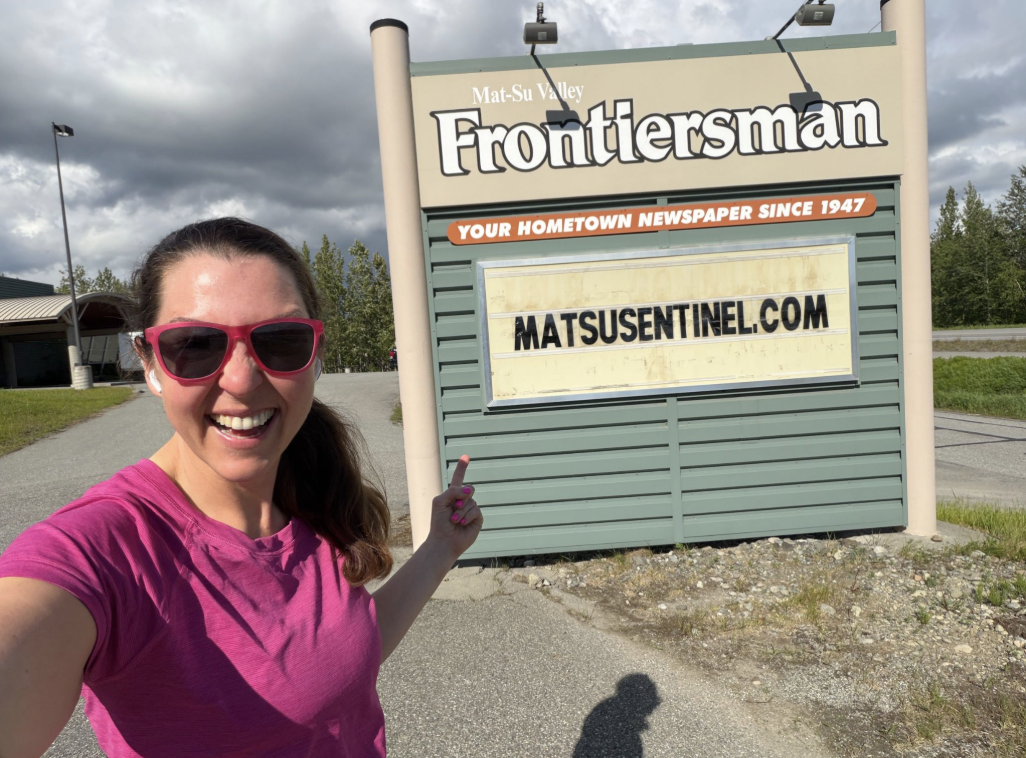
She pulls over and takes a selfie. It’s Amy in pink sunglasses and a ponytail, grinning under a moody Alaska sky, pointing at the Mat-Su Valley Frontiersman's roadside sign. It reads "Your hometown newspaper since 1947” and on the marquee below it, where advertising deals might once have been displayed, someone has spelled out a new message: MATSUSENTINEL.COM.
Then she gets back on the road, fights the Mat-Su Valley traffic and picks up exactly where she left off: telling the story of how a newsroom of one ended up owning an 80-year-old newspaper. Tiny News Collective member Amy Bushatz is the founder, editor and approximately entire staff of the Mat-Su Sentinel, the nonprofit digital newsroom that last month acquired the Mat-Su Valley Frontiersman from Arizona-based Wick Communications.
Mergers and acquisitions are not common in the small independent news ecosystem. Among the 90-plus active members of the Tiny News Collective, we can only point out one other recent ownership transfer. Kari Mar, editor and publisher of La Conner Community News — the nonprofit she launched in 2025 after the Washington town's weekly paper shut down — recently became the owner of The Northern Light, a weekly serving the border communities of Blaine, Birch Bay and Semiahmoo, along with the All Point Bulletin and three magazines. The papers belonged to Patrick Grubb and Louise Mugar, a married couple heading into retirement, who handed both publications to Mar as a gift rather than let them go dark.
In Portland, Oregon, when Mary DeHart also decided to retire after decades at the helm of the Hollywood Star News, a monthly that prints 15,000 copies across Northeast and North Portland, she announced the sale in her own newspaper. She wanted the Star to stay in local hands because it was created as a publication of "people from the community, writing about the community." Todd Milbourn and Lisa Heyamoto, longtime journalists and former University of Oregon journalism professors, were exactly the kind of devoted readers who pored over each issue to feel more connected to their neighborhood. They found DeHart's announcement on Page 5, purchased the Star in 2024, and have been running it through their newly formed Electric Heights Publishing Co.
 TNC
TNC
Read about how Amy Bushatz and another Collective member Kari Mar both added community newspapers to their portfolios.
Good ideas happen when it’s sunny
In Alaska, according to Amy, good ideas happen in the summer. Otherwise, the weather is simply too rough. In August 2022, Amy discussed with a fellow journalist with decades in Alaska local news that the Frontiersman might not survive its corporate ownership forever. And if it didn't, someone local would have to be ready to acquire it. Maybe Amy could be that someone. By the end of that coffee, sitting outside a shop that happens to be kitty-corner to her office today, her friend was calling the hypothetical project "our newspaper."
Then, on a cold Friday in mid-December 2022, Wick Communications abruptly ended the print edition of the Anchorage Press, the alt-weekly it also owned, and laid off its staff days before Christmas. Amy was on the Press's freelancer list, so she got the email like everyone else. She picked up her phone and texted her friend in a panic. "Does this mean the Frontiersman is shutting down too? Because I am not ready. I didn't do the thing I said I was going to do to get ready for this."
The Frontiersman survived that day, but Amy thought she had missed her chance. "It felt very much like an Elizabeth Gilbert Big Magic moment," she said. "I know from experience that ideas go to someone else if you don't use them."
In 2023, she left Military.com, where she had spent 13 years and managed a team of 15. "Buying the Frontiersman and starting a nonprofit newspaper were the same plan," she said. She was building an organization for three possible futures: buy the paper to keep it alive, exist as the Valley's newsroom if it died, or be the obvious hands for Wick to pass it to.
But before any of that, she had two things to build from scratch.
The first was community credentials. After more than a decade running a national website remotely, nobody in the Mat-Su Valley knew who she was. "I've got to go show up at the borough building and convince them that, ‘Hello, I am your news reporter — self-appointed, by the way. Please believe me.’"
To build that credibility she took her friend's suggestion and went to work part-time at the Anchorage Daily News, 20 hours a week. Her first assignment was the Giant Pumpkin Weigh-Off. The whiplash of daily coverage included a bridge construction story one day, and a tax measure the next that left her, in her words, “drowning in topics.” She did it anyway, and took it seriously: "I know what an editor is looking for, and I wanted to deliver that," she said.
The second was setting up the nonprofit itself, which meant confronting "the monumental task of trying to figure out how the heck a person starts a nonprofit newspaper. Which, by the way, is hard. And ambiguous." She joined the Tiny News Collective in 2024 and a CUNY entrepreneurial journalism course to give her structural support at a critical time. She notes these resources didn't exist for founders a decade earlier.
Somewhere in that first year, the grand plan split in two: The Frontiersman went on a shelf, and the immediate task became getting the Mat-Su Sentinel off the ground. But once the Sentinel launched and was starting to see some signs of early success, she began looking at how to position herself for her north star goal.
Within months, an introduction led her to an editor in Half Moon Bay, California, who was part of a local movement to take his community’s paper back from Wick and who shared the email address of the company's family owner and CEO. Amy cold-emailed the head of an 11-state media company and told him that when he was ready to get out of Alaska, she wanted to buy his paper. He never replied. "I track my email, so I could see that he read it."
In January 2025, on a cruise ship where she was theoretically unplugged, she checked the Frontiersman's website at night, while lying in bed near her sleeping family, and found a story announcing that Wick was looking for a buyer.
"I thought: Ah! Now it starts." Except she had no money and no idea how this worked.
 TNC
TNC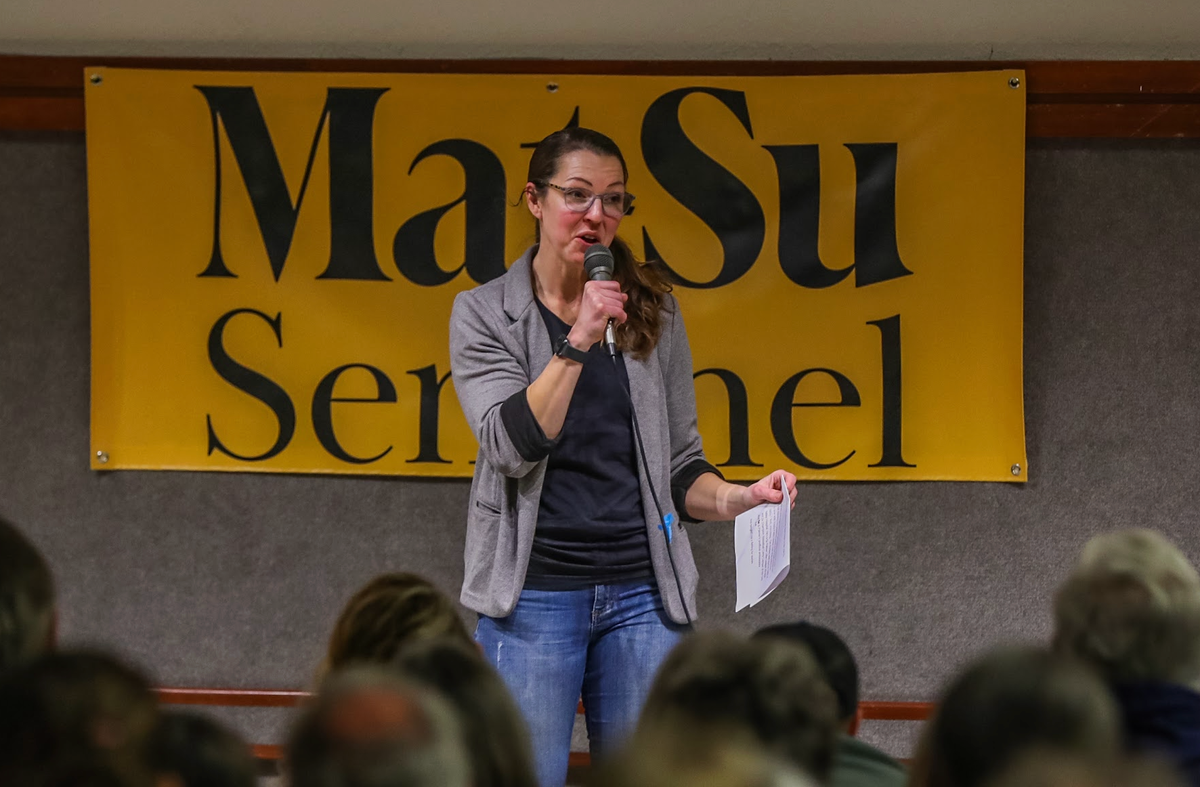
Is the juice worth the squeeze?
Back home, she raised her hand anyway. Wick's broker sent over the business packet that goes to prospective buyers with the financials, assets and the shape of the thing for sale. It was clear from the documents that the buyer and the seller were not in the same ballpark. Wick wanted to sell everything at once — the property, the building, the printing press — and the gap between what they were asking and what Amy could imagine paying was an order of magnitude. She was also coming with no acquisition experience and no acquisition budget.
"There were plenty of times that I questioned whether this was a good idea and worth doing," she said.
She was also clear about what she refused to buy. Advisers told her print was due for a comeback; but she was immovable on the printing press. "That is not my core competency. I cannot run a successful editorial online product and a successful print product at the same time." What she wanted was the brand, the subscribers and the digital presence which is precisely the part that's hardest to price. "Putting a valuation on an intellectual property purchase is really ridiculously complicated, and it's not clear math."
The answer came from the bottom of an industry newsletter. An Alaska Press Club email mentioned possible funding for local expansion; Amy responded, because she was responding to literally everything. The thread led to David Grant, general manager of partnerships at Blue Engine Collaborative, who didn't have money for her but offered to help with the valuation.
"One of my primary strategies of life is taking the advice that I'm given," Amy said. "If somebody who knows what they're talking about gives you advice on something, maybe you should consider taking that advice and just doing what they said instead of thinking that somehow you're smarter than they are."
Grant's model priced four assets, each as a three-year customer lifetime value:
- The digital subscribers, each modeled across three years of attrition. The high-retention scenarios hold roughly nine in ten subscribers through the first year, low-retention scenarios about half — minus a small annual cut for payment processing. Multiplied across the file, the digital base was by far the largest asset on the table, accounting for roughly half the paper's value in every scenario.
- The print subscribers, given the end of print, were another story. Grant modeled these customers as if their primary product would be an e-edition (a PDF of a paper in lieu of a physical one) and with correspondingly high churn assumptions. Under those assumptions, a print subscriber was worth roughly a tenth of a digital one.
- The newsletter list, valued not by its size but by its conversion rate. The model assumes a small percentage of newsletter subscribers become paying supporters each year over the ensuing three years.
- A digital advertising line, which is the most conservative entry. That was an estimate of how much of the ad business might survive the transition. It is still a question mark if these largely print advertisers will follow a digital owner who doesn’t plan to keep printing.
At worst-case retention, converting the Frontiersman's audience would make the purchase pay for itself.
"Buying an established business gives you paying supporters and relationships with sponsors on day one,” Grant said, “and, as in the case of the Frontiersman, represents a massive opportunity to upgrade all digital aspects of the business.”
Armed with the valuation, Amy made her first offer in 2025, but Wick wasn't ready to split the business apart. So the conversation was put on hold.
What reopened it was timing she didn't control but was uniquely positioned to read. Wick had been consolidating around its Arizona papers, leaving Alaska a far-flung outlier. In February 2026, the Frontiersman announced plans to cut printing from two days a week to one. At a Saturday borough meeting on Valentine’s Day — not streamed, the kind Amy makes a point of attending — the Mat-Su Borough noted that the reduced schedule meant it could legally stop publishing public notices in the paper, a contract worth about $100,000 a year that the borough assembly could end by changing the law. "That really got me thinking — maybe things are changing," she said.
She expected a new offer window maybe by mid-2027. Instead, Wick engaged in mid-May 2026 and wanted to close by the end of the month.
The terms of the sale are confidential. Amy cannot legally disclose the price or the nitty-gritty of the negotiation, but the shape of those three weeks comes through anyway. Some of what came back across the table would have loaded the Sentinel with obligations a newsroom of one, running on a tight budget, simply couldn't carry, and on those she was prepared to walk.
Amy will happily tell you, in her own words, about all the ways she is not good at this. She had never bought anything bigger than a house. The biggest knowledge gap was the mechanics of this deal, and she filled it with John Cribb, a veteran newspaper broker who first gave her free advice about what to be thinking about. "And then ultimately, I hired him, because what I needed to think about was having somebody else think about that stuff." He helped her reframe her leverage and explained that there are costs for selling.
Among the Sentinel's board members is also a retired corporate attorney who spent his career on acquisitions and who had asked to join the board — long before any of this opportunity was possible — because a newspaper sounded interesting. "This person just fell out of the sky before my eyes," Amy said. Legal fees for the entire acquisition were $0.
And then there are the gaps no one can fill in advance: the things you discover after the keys change hands. Reviewing the site post-close, the contractor rebuilding the Frontiersman's digital archive flagged a licensing problem — syndicated content that should have come down when the previous owners' contracts ended, still sitting live on the site years later. Untangling it became Amy's job, and her contractor's painstaking work. "Is this something I should have noticed in due diligence? You'd have to know to look for that," she said. "I think this is just the fallout of buying someone else's problems, frankly."
 Mat-Su Sentinel Staff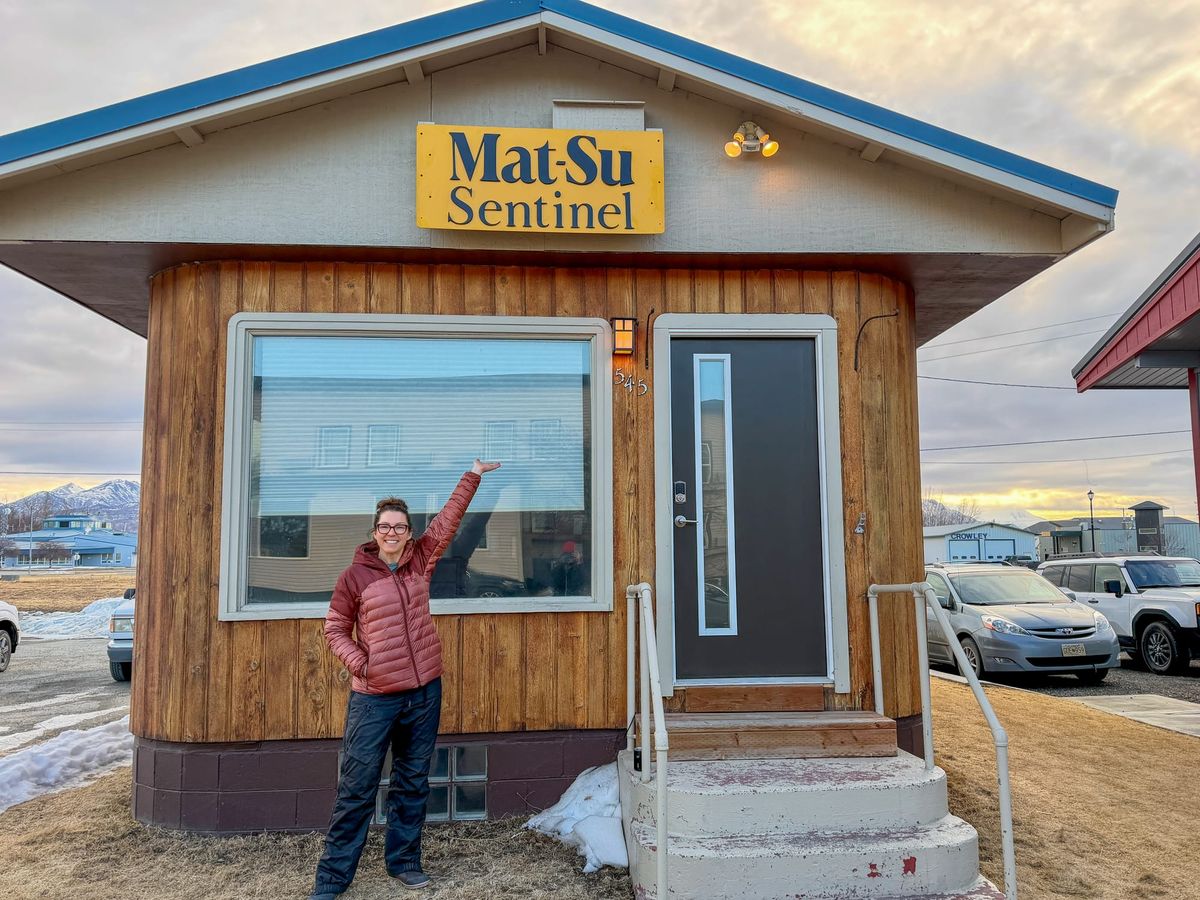
The doors are open
In the second week of June, the Mat-Su Sentinel turned 2 years old.
Amy marked the week by writing to her readers. Big things were happening, she told them about the recent acquisition. "It's a big deal," she wrote, "and we're still a little bowled over that it happened." Just months ago, Amy was predicting this deal wouldn't even be back on the table until 2027. "Imagine my surprise that it is today and this is over," she said. "I have been through a hurricane, frankly."
There was one more piece of news in the newsletter. "We also have an office now. A real one, with a sign bolted to the building and everything. And we want you to come see us." That Saturday, during Palmer's Colony Days festival, she invited the whole valley to an open house at 545 S. Alaska St. — to meet her in person, learn what she's building, grab a snack or share thoughts on the coverage.
Two years earlier, she had launched a website and appointed herself the community's news reporter. Now, the community had an address where it could find her, and on a Saturday afternoon in June, the doors were finally open.
Elaine Díaz Rodríguez is director of partnerships for the Center for Community Media at the Craig Newmark Graduate School of Journalism at CUNY, where she builds bridges between community and ethnic media outlets and the broader journalism support sector. She is a former membership director of Tiny News Collective.