

TNC newsrooms experiment with audience growth, sustainability through the Tiny Vitals metrics program
Apr 29, 2026
By Diane Sylvester
Tiny News has been supporting newsrooms through an innovative metrics program called Tiny Vitals. For the second cohort of the program, the focus was on newsrooms navigating major transitions — from closing print editions to launching new digital products, from refining audience strategies to building long-term financial plans.
In a recent Lightning Talks gathering on Zoom, newsroom leaders shared how they used the program to pause, examine their data, and rethink assumptions about how audiences find, engage with and support local journalism. They tried out paid social media campaigns, AI tools, in-person community presence, bilingual content and audience segmentation to improve engagement and sustainability.
Bridging journalism and audience engagement
Cindy Fisher, publisher of the Black Belt News Network in Selma, Alabama, joined the second Tiny Vitals cohort during a period of significant change. Last August, she made the difficult decision to close her print newspaper, the Selma Sun, transitioning fully to a digital operation and accelerating plans to expand regionally across Alabama and neighboring Mississippi.
“I found it valuable to look at my numbers because it’s something I don’t do regularly,” Fisher said.
With support from her coach, Jos Duncan Asé of Love Now Media, Fisher focused on audience growth as both a business necessity and a communication challenge. Her goal was to grow her email list and social media following while clearly signaling the shift from a print legacy brand to a regional digital news network serving rural communities that have lost multiple newspapers.
As part of that experimentation, Fisher launched a paid Facebook campaign — something she had not done before. The campaign generated 137 clicks for roughly $35 and produced about 12,000 impressions. She paired that effort with a test of Optin Monster pop-ups, which brought in 167 email sign-ups, though fewer ultimately completed the opt-in process. She thought Optin had a flat monthly fee of $268, but later realized it charged an additional $300+ tied to every 25,000 page views. That was a far higher cost than she anticipated. The experiment helped her understand both the potential paid tools for audience acquisition and the need to do deeper research on costs before buying into a new product.
Beyond growth tactics, Fisher explained she also developed a voice guide to help align the publication's tone and approach for trust and cultural context. Serving a largely African-American rural readership, she developed the guide to help ensure consistency across reporting, newsletters and promotional messaging. She also began experimenting with AI tools to support audience-facing workflows, including a welcome email series for new subscribers, campaign messaging, calls to action and visual assets created with Canva.
 TNC
TNC
Connecting with community and strengthening sustainability
For Sheila Reinecke of Ottawa News Network in Michigan, the second round of Tiny Vitals coaching reinforced a lesson: in-person community engagement can expand a committed digital audience.
Working with coach Simon Galperin, Reinecke and her team began by articulating ambitious goals — increasing subscribers, reaching more county residents and launching a Q4 fundraising campaign. Through coaching, Reinecke said those goals evolved into a clearer understanding of how mission alignment and visibility in the community can drive results.
“We learned that the more present we were in our community, the more people signed up,” Reinecke said.
When the newsroom’s executive editor spoke at local events, the team consistently saw 20 to 30 new newsletter sign-ups. Since joining Tiny Vitals, Ottawa News Network’s subscriber base has grown by 28.5%. That growth helped validate the newsroom’s belief that digital-first operations still require physical presence and relationship-building.
Coaching also supported Ottawa News Network’s efforts to strengthen its funding base. Reinecke said the team built relationships with community foundations and secured commitments to support an audience research project in 2026. They also launched a Q4 fundraising campaign that benefited from both national matching programs and local matches, including $25,000 in local support.
At the same time, Reinecke used coaching to step back and focus on organizational health. The newsroom completed strategic planning sessions, developed a media kit to support donor and sponsor outreach, and clarified priorities to avoid overextending themselves during its early growth phase.
Leveraging multimedia for engagement
Emmanuel Paul of Caribbean Television Network (CTN) shared how experimentation with distribution, multimedia and revenue diversification has helped support their mission to serve Haitian and Caribbean audiences across the U.S. and abroad as issues around immigration have become more urgent.
Over the past year, CTN opened a new studio space in Boston to support podcasts, live broadcasts and guest interviews. Paul said through their work with Tiny News Collective and the Local Media Consortium, CTN has been able to expand its distribution on platforms like NewsBreak, where the outlet gained approximately 6,000 followers and continues to grow by 600 to 1,000 followers per month.
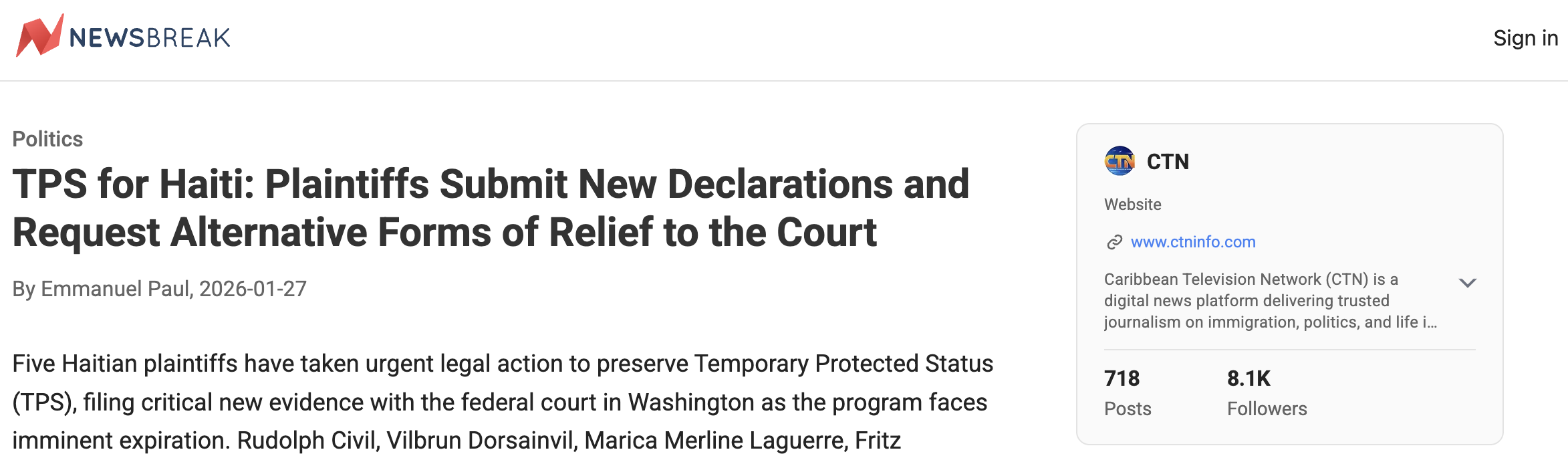
Paul described how audience behavior pushed CTN to evolve beyond text-based reporting. As immigration news accelerated — sometimes producing 5 to 10 major stories per day — the newsroom found that many audience members preferred listening and watching rather than reading.
CTN experimented with live video streams lasting several hours a day, covering news from cities with large Haitian communities such as Boston, New York and parts of Florida. The team also tested converting articles into videos and producing bilingual content to better meet audience needs.
Because of the sensitivity of immigration coverage, Paul emphasized the importance of providing context alongside breaking news, ensuring that audiences were informed without causing unnecessary fear or confusion.
Targeted audience segmentation
Eric Falquero of The 51st described how coaching helped the Washington, D.C.-based newsroom move away from serving a general audience toward a more focused, intentional audience strategy.
When applying to Tiny Vitals, The 51st proposed ambitious goals around defining its serviceable market, converting free subscribers to paid members, and identifying major donors. Through coaching, the team narrowed its scope: identifying and testing strategies for three specific audience segments of high potential for their newsroom.
The team began by launching a campaign aimed at one of their target groups: past fans and readers of DCist who don’t yet know The 51st exists. To do that they asked for super fans of The 51st to participate in a community referral program. The effort was integrated into their end-of-year campaign and paired with a plan to monitor the responses. The team was highly aware that D.C. residents have been facing financial strains with furloughs and layoffs. So instead of focusing on donations during the end-of-year campaign, they wanted to offer a way for their audience to support them that didn’t strain people’s finances: by growing subscribers. The team tested direct messaging via newsletter appeals and social media posts.
 The 51st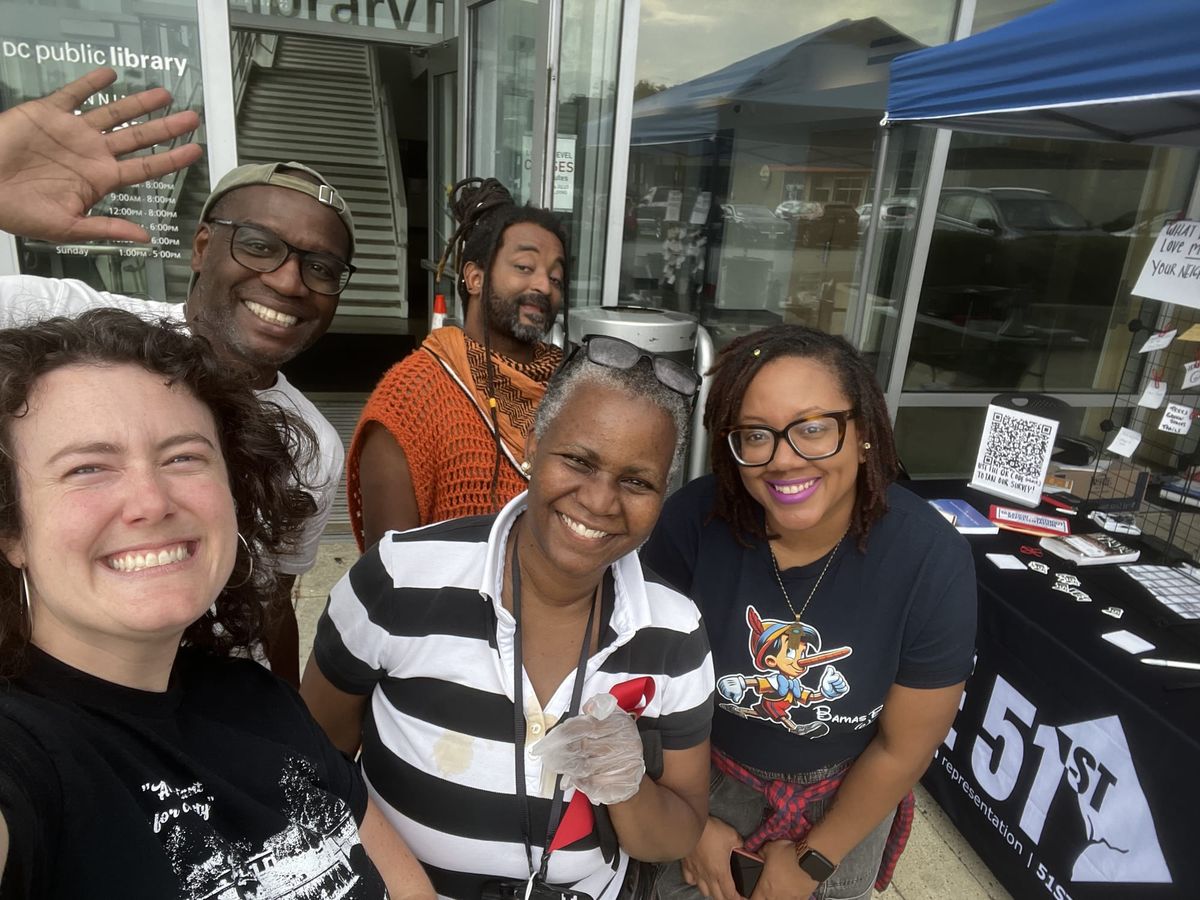
In parallel, The 51st is building on in-person engagement where community connectors collected sign-ups manually and tagged subscribers to track outreach efforts. These higher-touch strategies reflected the newsroom’s commitment to serving communities that have historically been undercovered and underinvested, currently focused on Ward 7 and D.C. Natives.
Data-driven insights for content and fundraising
Caitlyn Schmidt of Tucson Spotlight shared notes from her work with coach Vania André on using audience data to guide editorial, distribution and fundraising strategies.
The newsroom developed a custom audience report to better understand how readers arrive at stories, which platforms drive engagement, and how content performs over time. Early findings showed traffic growing from referral platforms such as Nextdoor and Google News, as well as a base of returning readers who navigate directly to the site.
The report helped Tucson Spotlight identify evergreen stories that continue to resurface and generate traffic. Those insights informed new distribution strategies and supported experiments with donation placements, tying fundraising appeals to moments of heightened reader engagement.
The team also began analyzing donor behavior, including frequency and average gift size, to inform future surveys and outreach. These experiments helped bridge the gap between editorial impact and financial sustainability.
Disclosure: The author of this article works for Tiny News Collective as a consultant. She worked as a consultant with The 51st, one of the newsrooms featured in this report.
Diane Sylvester is an award-winning journalist working as a newsroom consultant, writer and editor with more than 25 years of experience in public-interest reporting. A longtime newsroom leader and executive, she advises newsrooms and nonprofit media organizations on editorial systems, sustainable newsroom models, and team development, with a focus on building and supporting diverse newsrooms. She is a contributing writer to Editor & Publisher, covering innovation, media policy, press freedom, and the power dynamics shaping journalism and she works as a consulting senior editor on investigative projects.