
By Jesse Hardman & Amy L. Kovac-Ashley
Last year, we announced a partnership between the Listening Post Collective and the Tiny News Collective to coordinate our support for leaders in the early stages of providing news and information to and with their communities. In line with our shared values of listening first, community collaboration, civic health and integrity, we want to share what we’ve been learning.
A quick by the numbers accounting: Between us, we now share 10 partners, and that list is growing. These are folks who are both members of Tiny News Collective and grantees of the Listening Post Collective. Through our coordinated work, we’ve witnessed how people start with one organization and then connect with the second. What we’ve observed is that the flow goes both ways: TNC → LPC and LPC → TNC.
That drew our curiosity, and we wanted to know more. So we asked some of our overlapping local partners about their experiences (we also included overlapping LION members). We wanted to know what’s complementary about our services, and what we could improve on. People reported that we do a nice job creating community with other peers in our networks building grassroots media, with LPC pairing learning with funding and TNC excelling at operations building and founder support.
 TNC
TNC
Folks said they want more case studies and historical models of what impact and success look like for grassroots media. They want tested templates for hiring and fundraising campaigns. They want better advocacy to funders who are afraid to invest in smaller outlets. And they want a unified help desk for tech assistance that spans different support organizations like ours.
We were told some services can feel “redundant,” when we offer support around ubiquitous topics like digital security and audience growth. These partners agreed that we’re most valuable when we stay in tighter lanes and provide clarity on how what we each do is unique.
Most of all, they shared amazing insights, including this one: “Sustainability isn’t just about revenue ideas — it’s about whether the day-to-day machinery of the newsroom actually works. Helping founders build that machinery would be the single most valuable shift for me.”
As we thought more about what we observed and what we heard directly from our partners, two ideas came to us: 1) We need to change our thinking about how people experience our work, and 2) We need to change the language we use when we talk about the work we do.

A lot of thinking in our space can feel linear, a straight line from the Listening Post Collective’s community-level work leads to Tiny News Collective’s goal of helping community-led news launch and grow, and so on through support from other JSOs. The reality is, from Atlanta, Georgia, to the Matanuska-Susitna Borough, Alaska, community information needs and local news makers’ realities don’t move in a straight line. There’s not one formula for serving a community with news and info, or one route to creating a resilient local media project.
Instead, people and organizations have different needs at different times, and they need a support system that’s flexible, self-determined, but not prescriptive. With this new way of thinking, we wanted to emphasize their agency in navigating the support they receive, not presupposing what direction they would go. These grassroots news and information providers are travelers making their way in a complex system.
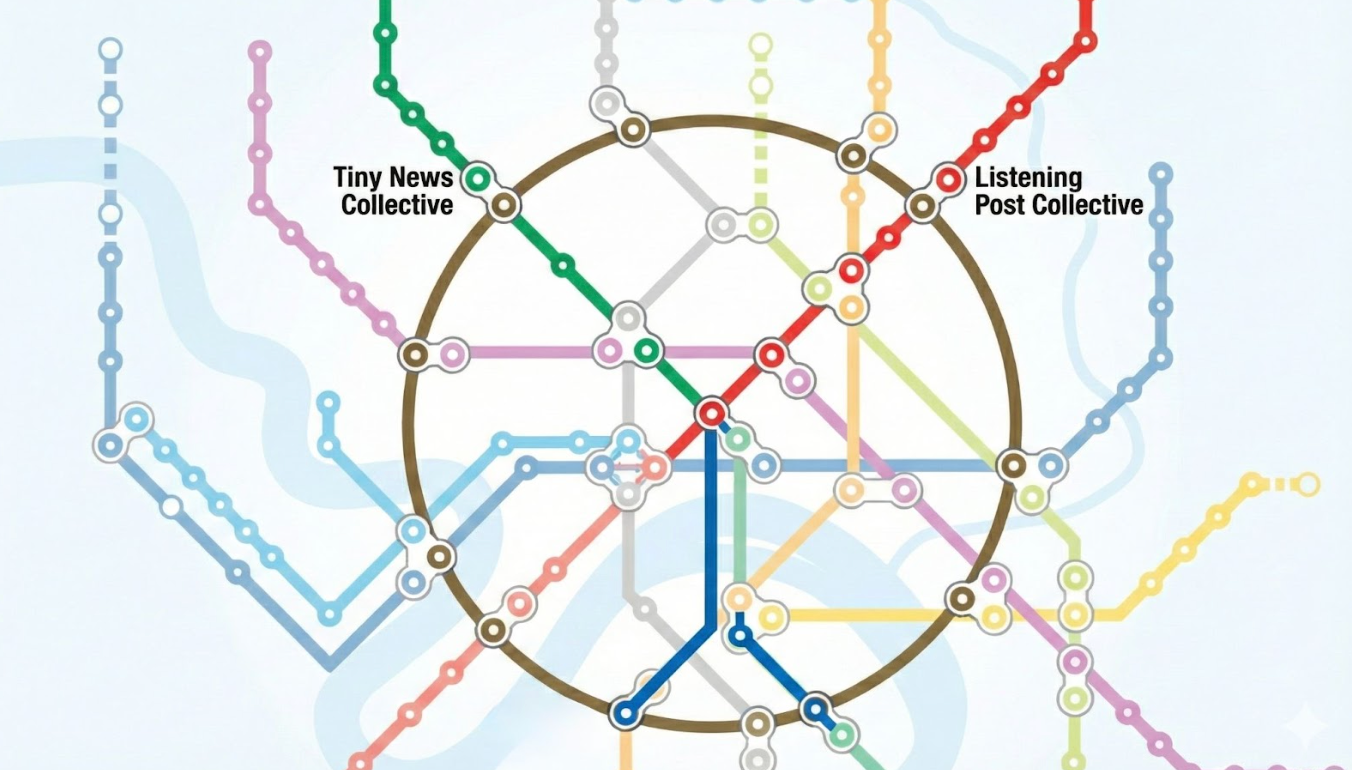
So we bent that linear approach, taking the simple, straight line and refashioning it into something new. The result looked an awful lot like the Moscow Metro map, with intersecting train lines, transfer stations from one line to another and a circle line to make it more efficient to get around. (N.B.: Amy studied in Moscow many years ago and has fond memories of how well the transportation system worked and how beautiful the stations are.)
We started to place ourselves as lines on the map and envisioned other journalism support organizations as other routes, always making sure there was some way the lines could intersect for easy transfer.
The freedom to choose their direction is represented by a mantra that we’ve adopted as part of our collaborations: pathways not pipelines. We recognize that the future of local news is not predetermined; it is being created today by the people imagining new and culturally competent ways to provide their communities with the information they need and want to live fuller and more connected lives. Our job is to support our local partners as they ride the metro and explore new pathways.
Jesse Hardman is the founder of the Listening Post Collective. Amy L. Kovac-Ashley is the executive director of the Tiny News Collective.
Sign up for our monthly newsletter for ongoing updates, announcements, and resources for newsroom entrepreneurs.